Economy Hype technologies and their limitations

Don't get me wrong there, I'm a fan of Schumpeter, so the fact that we continually have disruptive innovation as an essential fact of capitalism is not new to me. And smart people underestimate the power and speed of change all the time, compare Ballmer, but also:

"I think there is a world market for maybe five computers."
Thomas Watson, president of IBM, 1943

"There is no reason anyone would want a computer in their home."
Ken Olsen, founder of Digital Equipment Corporation, 1977

I have like two dozens of those quotes on my work computer, will have to look those up sometime. So I accept that. But in the 1950s, people assumed there would be nuclear-powered vacuum cleaners a decade later. And flying cars were forecast for the near future already.

Also personally, yes, I still had a phone with rotary dial and I remember 56k dial-up connections very well. Once, my dad had a serious discussion with me because I had spent 67 MB in one month.

But the point is: for Blockchain, there are no viable applications yet. None. Considering that every company of a certain size has dabbled in Blockchain projects, it's pretty obvious that the hype has been sold well. And quantum computing seems all the rage, yet it rather seems a bit with them like with fusion reactors: great idea, but technically so challenging that we will likely be waiting for decades rather than years for breakthroughs.

Fair points. I just don't get too wrapped up any any of it. I am just strapped in and ready to enjoy the rise.
 
lol yeah man the internet wasn't gonna work either until it did, and then it didn't work on cell phones, until it did.

Keep on keeping on brother. You will be right until you are wrong.

Did you read that article I linked?

I'm not being a kneejerk skeptic. The questions that I'm asking you are sincere: show me the blockchain that can address the two issues that I named, and how it actually addresses them and you'll make a believer out of me. The observant reader will note that I didn't say that blockchain has no applications, and doesn't have the potential to be a transformative technology.

And yes, I did read the article.
 
I'm not being a kneejerk skeptic. The questions that I'm asking you are sincere: show me the blockchain that can address the two issues that I named, and how it actually addresses them and you'll make a believer out of me. The observant reader will note that I didn't say that blockchain has no applications, and doesn't have the potential to be a transformative technology.

And yes, I did read the article.
1) bigger blocks, faster networks and faster memory 2) scalability solutions like sharding

No it doesn't exist right now, yes it is being developed.

You win the argument until you don't, I can't prove you wrong until real world events transpire.

Or you are going to need a technical explanation I can't provide because I am not an engineer or a blockchain developer, just an enthusiast. So maybe I don't know what I'm talking about and you know much better than me. Or maybe you are not in the blockchain space and speaking on matters you are not an expert in. Can't really say and I think time will tell.
 
My point here? Don't believe the hype just yet, at least in the case of Blockchain and Quantum computing. And be aware that AI will often not work, and if it does, and you are involved in a business context, it does not absolve you from making decisions based on analysis, experience, and common sense.

Good thread. Just imo, we are so bad at predicting the future of technology that the best we can do is keep researching and investing in what's promising and hope for the breakthroughs to come. It's annoying that this is driven by hype, but what else is there to go on? We don't have many kids saying they want to crack algorithms when they grow up.

Driverless cars are almost here, at least. That's pretty big and it's happening quickly.
 
Throw 3D printing in there as well.
It has it's place (mostly in prototyping or bespoke production), but it's not the cornucopia or some sort of Marxist fantasy of every man owning the means of production.
 
We were supposed to have run out of IPv4 addresses like 10 years ago and switch to IPv6 and I've yet to see a company that uses IPv6.

That's because it's not broken yet. If the IoT isn't just hype, that could easily change.
 
That's because it's not broken yet. If the IoT isn't just hype, that could easily change.

I don't believe it is. Alexa and others have brought a whole new dynamic into this.
 
I don't believe it is. Alexa and others have brought a whole new dynamic into this.

I wouldn't think so either, but I've been hearing companies like Intel tooting their horn about the IoT since the early 2000s. When LG introduced their internet fridge in 2000, it really did seem like it was just around the corner.
Instead it's more like Digital Convergence. It's the logical progression and everyone's been talking about it for ages, but the reality still takes a couple of decades before it's more than a buzzword or a gimmick.

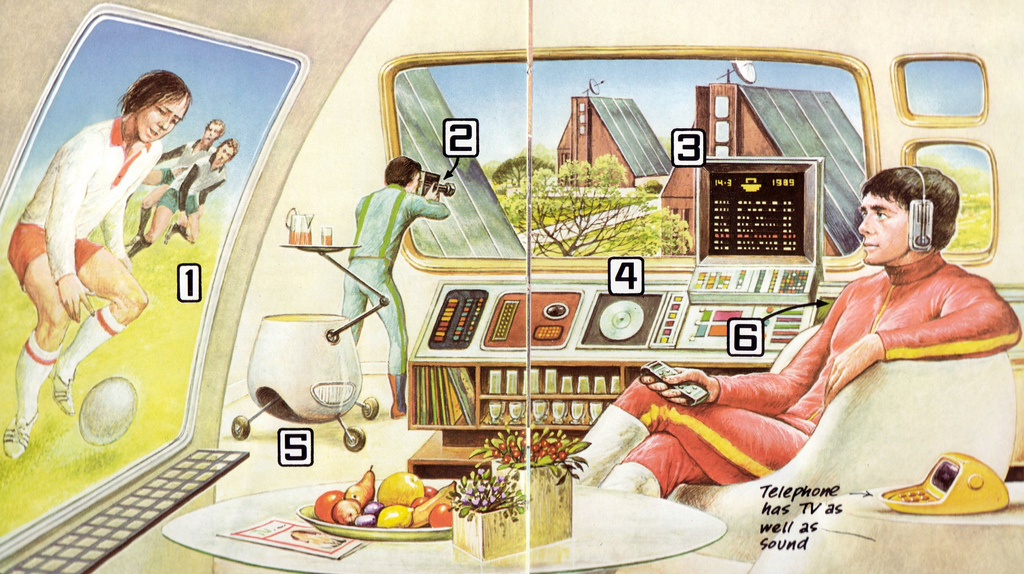
The Usborne Book of The Future. 1979. I had a copy of this back then.
Their idea of 1989. They weren't wrong, just a little optimistic about the time frame.

usborne-future-3.jpg

This living room has many electronic gadgets which are either in use already or are being developed for people to buy in the 1980s.

1. Giant-size TV. Based on the designs already available, this one has a super-bright screen for daylight viewing and stereo sound system.

2. Electronic video movie camera, requires no film, just a spool of tape. Within ten years video cameras like this could be replaced by 3-D holographic recorders.

3. Flat screen TV. No longer a bulky box, TV has shrunk to a thickness of less than five centimetres. This one is used to order shopping via a computerised shopping centre a few kilometres away. The system takes orders and indicates if any items are not in stock.

4. Video disc player used for recording off the TV and for replaying favourite films.

5. Domestic robot rolls in with drinks. One robot, the Quasar, is already on sale in the USA. Reports indicate that it may be little more than a toy however, so it will be a few years before 'Star Wars' robots tramp through our homes.

6. Mail slot. By 1990, most mail will be sent in electronic form. Posting a letter will consist of placing it in front of a copier in your home or at the post office. The electronic read-out will be flashed up to a satellite, to be beamed to its destination. Like many other electronic ideas, the savings in time and energy could be enormous.
 
The Usborne Book of The Future. 1979. I had a copy of this back then.
Their idea of 1989. They weren't wrong, just a little optomistic about the time frame.

usborne-future-3.jpg

This living room has many electronic gadgets which are either in use already or are being developed for people to buy in the 1980s.

1. Giant-size TV. Based on the designs already available, this one has a super-bright screen for daylight viewing and stereo sound system.

2. Electronic video movie camera, requires no film, just a spool of tape. Within ten years video cameras like this could be replaced by 3-D holographic recorders.

3. Flat screen TV. No longer a bulky box, TV has shrunk to a thickness of less than five centimetres. This one is used to order shopping via a computerised shopping centre a few kilometres away. The system takes orders and indicates if any items are not in stock.

4. Video disc player used for recording off the TV and for replaying favourite films.

5. Domestic robot rolls in with drinks. One robot, the Quasar, is already on sale in the USA. Reports indicate that it may be little more than a toy however, so it will be a few years before 'Star Wars' robots tramp through our homes.

6. Mail slot. By 1990, most mail will be sent in electronic form. Posting a letter will consist of placing it in front of a copier in your home or at the post office. The electronic read-out will be flashed up to a satellite, to be beamed to its destination. Like many other electronic ideas, the savings in time and energy could be enormous.

Awesome stuff.
 
1) bigger blocks, faster networks and faster memory 2) scalability solutions like sharding

No it doesn't exist right now, yes it is being developed.

You win the argument until you don't, I can't prove you wrong until real world events transpire.

Or you are going to need a technical explanation I can't provide because I am not an engineer or a blockchain developer, just an enthusiast. So maybe I don't know what I'm talking about and you know much better than me. Or maybe you are not in the blockchain space and speaking on matters you are not an expert in. Can't really say and I think time will tell.

I'm a dabbler just like yourself, although I am an engineer. I guess you could say I'm a ''true believer'' in the technology, but we disagree on what the ''technology'' really is. The technology is the distributed, public, immutable ledger, not necessarily blockchain. So while I see blockchain being able to address some issues very well, I just don't currently see the solution for the as of yet futuristic problem of IoT.

I think it's worth pointing out that IoT may itself never really be a thing (does my blender really need wifi and a crypto wallet?), and therefore an ultra scalable solution like Iota might never really see its business case come to fruition. In that case a coin with much more market volume and current adoption has the inside track. But, for example, self driving cars alone could be that business case.
 
Awesome stuff.

Throw Augmented Reality and Virtual Reality on that heap of, "decades old buzzwords that might eventually become a commonplace consumer reality, if not the disruptive innovation they were imagined to be".
Still held back by being too expensive, too bulky, lacking mobility and most of all, the lack of a "Killer App".
 
Those are all good. Not a technology but SETI has been a disappointment and there was a lot of hype by scientists about life outside this planet. It's been claimed many times but all are disputed.

Astrobiology. That field.
 
So there are a couple of buzzword technologies that are supposedly changing our economies in a major way. And some of them have already achieved remarkable things, so they cannot be discounted right away.

But the promises some of these technologies are making are gonna be hard to fulfill.

Example 1: Blockchain

Blockchain has been the hot thing for a couple of years now, but has not delivered a lot of tangible benefits outside of crypto currencies.

Study goes looking for successful blockchain projects, finds none:

https://www.theregister.co.uk/2018/11/30/blockchain_study_finds_0_per_cent_success_rate/

No really, none. Not few. Not a single one.

"We found a proliferation of press releases, white papers, and persuasively written articles," Burg et al wrote on Thursday. "However, we found no documentation or evidence of the results blockchain was purported to have achieved in these claims. We also did not find lessons learned or practical insights, as are available for other technologies in development."

(...)

Blockchain vendors were keen to puff the merits of the technology, but when the three asked for proof of success in the field, it all went very quiet.

Therefore, this statement by Australia's Digital Transformation Agency is hardly surprising:

for every use of blockchain you would consider today, there is a better technology

https://www.zdnet.com/article/dta-d...-for-every-use-there-is-a-better-alternative/


Example 2: Artificial Intelligence

We've all read about the impressive feats e.g. in the area of the game Go, and many applications today have implemented some AI features already. I myself have been leading an AI project for the last couple of months and I'm quite optimistic.

But many successful applications of "AI" are actually just applications of Bayesian statistics. And when we get into the area of machine learning and deep learning, it gets a bit muddy. It seems that generally speaking, you need to expect most AI projects to fail:

https://blogs.wsj.com/cio/2017/12/1...ll-in-the-enterprise-despite-potential-panel/

For example, Monsanto's Director of Digital Partnerships said that

A 99% failure rate with a current slate of 50-plus deep-learning projects is acceptable because “that 1% is going to bring exponential gain"

So yes, AI is likely going to bring benefits, even though - and that's the key issue with AI - we won't really be able to tell why single decisions or proposals built on AI have come about. Nobody's gonna be held accountable for fuckups because it's "been the AI". These implications of AI are not discussed enough in my opinion.

Example 3: Quantum computing

Here, I'm just going to quote from a very interesting article. You can read the whole thing though, it's good:
https://spectrum.ieee.org/computing/hardware/the-case-against-quantum-computing

Quantum computing is all the rage. It seems like hardly a day goes by without some news outlet describing the extraordinary things this technology promises. Most commentators forget, or just gloss over, the fact that people have been working on quantum computing for decades—and without any practical results to show for it.

We’ve been told that quantum computers could “provide breakthroughs in many disciplines, including materials and drug discovery, the optimization of complex manmade systems, and artificial intelligence.” We’ve been assuredthat quantum computers will “forever alter our economic, industrial, academic, and societal landscape.” We’ve even been told that “the encryption that protects the world’s most sensitive data may soon be broken” by quantum computers. It has gotten to the point where many researchers in various fields of physics feel obliged to justify whatever work they are doing by claiming that it has some relevance to quantum computing. [...]

In light of all this, it’s natural to wonder: When will useful quantum computers be constructed? The most optimistic experts estimate it will take 5 to 10 years. More cautious ones predict 20 to 30 years. (Similar predictions have been voiced, by the way, for the last 20 years.) I belong to a tiny minority that answers, “Not in the foreseeable future.” Having spent decades conducting research in quantum and condensed-matter physics, I’ve developed my very pessimistic view. It’s based on an understanding of the gargantuan technical challenges that would have to be overcome to ever make quantum computing work.

[...]

To my mind, quantum computing researchers should still heed an admonition that IBM physicist Rolf Landauer made decades ago when the field heated up for the first time. He urged proponents of quantum computing to include in their publications a disclaimer along these lines: “This scheme, like all other schemes for quantum computation, relies on speculative technology, does not in its current form take into account all possible sources of noise, unreliability and manufacturing error, and probably will not work.”


My point here? Don't believe the hype just yet, at least in the case of Blockchain and Quantum computing. And be aware that AI will often not work, and if it does, and you are involved in a business context, it does not absolve you from making decisions based on analysis, experience, and common sense.
I agree with pretty much all of this. In particular, the key term in your mention of quantum computers is "useful quantum computers". As it stands now, outside of theory, there isn't even any hard evidence that we can build one that will work better than conventional computers.

Blockchain is a really new technology, though, so it's hardly surprising it hasn't reached anything close to what a reasonable person could identify as its potential. And yeah, AI is an issue that needs more public discourse. "Predictive Policing" algorithms already being used have proved very problematic.
 
Last edited:
Throw Augmented Reality and Virtual Reality on that heap of, "decades old buzzwords that might eventually become a commonplace consumer reality, if not the disruptive innovation they were imagined to be".
Still held back by being too expensive, too bulky, lacking mobility and most of all, the lack of a "Killer App".


One day

6gIBmLc.jpg
 
I'm a dabbler just like yourself, although I am an engineer. I guess you could say I'm a ''true believer'' in the technology, but we disagree on what the ''technology'' really is. The technology is the distributed, public, immutable ledger, not necessarily blockchain. So while I see blockchain being able to address some issues very well, I just don't currently see the solution for the as of yet futuristic problem of IoT.

I think it's worth pointing out that IoT may itself never really be a thing (does my blender really need wifi and a crypto wallet?), and therefore an ultra scalable solution like Iota might never really see its business case come to fruition. In that case a coin with much more market volume and current adoption has the inside track. But, for example, self driving cars alone could be that business case.

I figured you must be requiring a technical depth I can't pretend to be able to achieve.

But I think Factom is one of the rare projects actually working with large entities on real world solutions, DHS, Gates foundation grants, Equator mortgage stuff, its in the works and there is evidence it's very pssoble. But you are right that it hasn't happened yet, and it could still fail. I doubt you know anything about Factom they are under the radar.

Ultimately I can't prove something is going to happen, we can just make theoretical points and I don't think I can make good enough ones for you with my shallow knowledge.

I disagree with you though like you said.
 

To be fair VR's come a long way since Dactyl Nightmare in 1991, although it hasn't exactly been a continuous development.
I paid $5 (AUD) for a shot back in 1992 lasting less than 5 minutes.
Didn't quite live up to my Neuromancer ideals.

 
I figured you must be requiring a technical depth I can't pretend to be able to achieve.

But I think Factom is one of the rare projects actually working with large entities on real world solutions, DHS, Gates foundation grants, Equator mortgage stuff, its in the works and there is evidence it's very pssoble. But you are right that it hasn't happened yet, and it could still fail. I doubt you know anything about Factom they are under the radar.

Ultimately I can't prove something is going to happen, we can just make theoretical points and I don't think I can make good enough ones for you with my shallow knowledge.

I disagree with you though like you said.

I don't actually know anything about Factom, so thanks for pointing them out to me. I'll do some more reading.
 

Forum statistics

Threads
1,280,223
Messages
58,267,870
Members
175,988
Latest member
xindispider
Back
Top