
- Joined
- Oct 6, 2004
- Messages
- 43,845
- Reaction score
- 15,063
It was removed from there too.
Interesting.
Still... can't put the quantum genie back in the bottle.

It was removed from there too.

It was removed from there too.
Yes, he's a butcher of the language, but he posts interesting science stories so I let it pass.

Yeah the powers that be will likely use the power to make us more like China.

"Meanwhile we're going to continue to mine Monero with your fridge""You have been banned from your Google™ refrigerator for violations of terms of service. Please increase your social credit score to regain access to your edibles."

A bunch of white people talking about supremacy.
Not woke at all google, not woke at all.


Not exactly apples to apples if you're talking about a processor that can only run a single algorithm.
It's not even clear from the reporting that it's Turing complete.
Apparently the experiment was run on a 53 qubit processor.
Edit: The reporting on this even on tech sites seems unusually bad.
Here's the paper that was removed.
For starters, I am not that keen on technology and computers.
Since I have never heard the word qubit, I want a simple explanation of what you can use for practical purposes. I can read on my work computer that it has an i7 processor. It's an HP elitebook and I think it's fast. What is the difference between the one I have and the one Google has? Do normal people need such a super computer?

It wasn't the terms you used that I was referring to, ditto the other person, I'm sure. It was the not so ideal construction of the clause, "an over 40 qubit quantum computer that had enough qubits to achieve a viable level to be at to achieve quantum supremacy." I'll say no more about it; I don't want to go all Captain Pedantic on you; it's an interesting topic, good OP. I have been waiting quite a while for evidence that the main issues had been overcome to achieve real-world practical quantum computing. As I understand the state of the art, up to now, no one really had any proof that a quantum computer could be built that outperformed conventional computing. If that has changed, we seem to be on the way to a very exciting era in computing and science in general.I thought the explanation was pretty basic that 40 qubits was a point where no supercomputer could match the size and performance of a quantum computer. Up to now small qubit machines where easy to dismiss as being fun science projects but little use in the real world. Even the massive 2000 qubit machine from D-Wave was dismissed as being useless for all but the most specific problems due to the design limitations. Example in D-Waves case was quantum annealing and the limitations it posed.
Sorry you think a rather mild off topic joke is being an a-hole.Quantum annealing (QA) is a metaheuristic for finding the global minimum of a given objective function over a given set of candidate solutions (candidate states), by a process using quantum fluctuations.
Anyways many on Sherdog are quantum level A-holes. Meaning huge like galactic level A-Holes who suck more energy out of a post then a blackhole in space sucks matter.

PEB said:Anyways many on Sherdog are quantum level A-holes. Meaning huge like galactic level A-Holes who suck more energy out of a post then a blackhole in space sucks matter
For starters, I am not that keen on technology and computers.
Since I have never heard the word qubit, I want a simple explanation of what you can use for practical purposes. I can read on my work computer that it has an i7 processor. It's an HP elitebook and I think it's fast. What is the difference between the one I have and the one Google has? Do normal people need such a super computer?


For starters, I am not that keen on technology and computers.
Since I have never heard the word qubit, I want a simple explanation of what you can use for practical purposes. I can read on my work computer that it has an i7 processor. It's an HP elitebook and I think it's fast. What is the difference between the one I have and the one Google has? Do normal people need such a super computer?
It wasn't the terms you used that I was referring to, ditto the other person, I'm sure. It was the not so ideal construction of the clause, "an over 40 qubit quantum computer that had enough qubits to achieve a viable level to be at to achieve quantum supremacy." I'll say no more about it; I don't want to go all Captain Pedantic on you; it's an interesting topic, good OP. I have been waiting quite a while for evidence that the main issues had been overcome to achieve real-world practical quantum computing. As I understand the state of the art, up to now, no one really had any proof that a quantum computer could be built that outperformed conventional computing. If that has changed, we seem to be on the way to a very exciting era in computing and science in general.
Sorry you think a rather mild off topic joke is being an a-hole.
Don't worry your not the one I'm addressing it's the ones who need to salt their negativity on someone because they think it's cool. Especially the ones who have to swear on every other word to make a point. Adult level discussion are 3 words never used on a Sherdog forum at least together without it been equated to a porn thread.Why you no @ me, bro?
Don't worry your not the one I'm addressing it's the ones who need to salt their negativity on someone because they think it's cool. Especially the ones who have to swear on every other word to make a point. Adult level discussion are 3 words never used on a Sherdog forum at least together without it been equated to a porn thread.


I'll give you the 50'000ft explanation of it.
In your i7 HP, as well as all home usage computers and all 'standard model' computers the smallest data unit is called a binary bit - which is a 1 or 0, yes or no, on or off transistor. Eventually these transistors get so small they are approaching the atomic level and beyond that, the subatomic. Hence the Quanta bit or Qubit (sub atomic) Now the reason these have the potential to be faster -- much, much faster, is because a single qubit can be a 1, 0 or 1 and 0 depending to the point of application - its based on the quantum mechanics of superposition. This means fewer qubits can achieve greater processing ability than many binary bits.
Beyond superposition, theories of how quantum mechanics can be applied to quantum computing also use the concept of quantum entanglement or quantum tunneling. Think of a maze puzzle. You have to get from start to the finish. Our standard computers, like our brains, do this by trying each option until it figures out the correct pathway. A quantum computer could theoretically try all options at once (a form of superposition) to achieve this objective much faster. Or, using tunneling -- it could just bypass the barriers altogether and go straight from end to another. The other theory is it could use quantum entanglement in which each point going through that maze, can share information with all other points in actual real time because all those points are infact, the same point with the same brain.
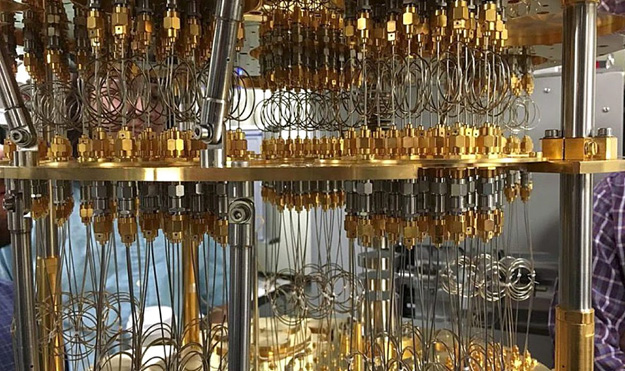
Of course all that is theoretical applications -- right now they are huge, clunky, loud machines that are used for singular applications.

A quantum computer can do everything a normal computer can, but it's like a million times faster. It's like comparing a Power Wheels jeep vs a rocket ship.
Thank you and the other 2 posters who satisfied my curiosity. But what is the point of something that is 1 million times faster if you do not even have time to react to what had just happened?
I remember when Goran Ivanisevic played tennis. He was known for his many serve aces. The tennis duels became shorter and it became boring to watch as things went too fast. Therefore, I am content with the ladies as their game is more enjoyable to watch as the game goes slower.
Quick is not always the best.


