• Xenforo Cloud is upgrading us to version 2.3.8 on Monday February 16th, 2026 at 12:00 AM PST. Expect a temporary downtime during this process. More info here

Comic Book Discussion Thread V.17 (Batman/Deadpool Crossover; R.I.P. Peter David and Jim Shooter)

Not sure if this thread is “dead” or if another one has taken its place but didn’t really feel like this deserved its own thread, but does anyone here read any of the Conan comics? I took my son to a comic book store last weekend and on a whim I decided to buy myself some Dark Horse Conan comics, but only ones based upon Robert E Howard’s original short stories. I have an Conan anthology book with all of Howard’s original Conan short stories so I was curious in checking out how those story’s adaptations into comics compare.

The funny thing is I went to another comic book store yesterday during my lunch break and picked up a few more but the store absolutely reeked of weed, and I never even thought about the comics I bought absorbing the smell. I get home and throw them on my bedside table, and then after work I went into my room and it stinks like weed now too. I knew my wife would be pissed so I’ve stored them inside a Tupperware container to stop them from fumigating our room with weed odour.

So I have two questions:

1. For anyone that’s a fan of Conan comics do you have any recommendations?

2. Anyone have any ideas on how I can get the weed odour off these comics so I can’t just put them on a shelf instead of keeping them in Tupperware in perpetuity?
Never really managed to get into Conan comics, although I've checked out some of the art because I was really into John Buscema a couple of years ago. But I've heard people raving about the Conan series published by Titan Comics. It has 18 issues out so far and the art is done by Robert De La Torre who is doing a really good copy of Buscema's style, and maybe some Joe Kubert sprinkled in there as well.


Q.jpg
 
Not sure if this thread is “dead” or if another one has taken its place but didn’t really feel like this deserved its own thread, but does anyone here read any of the Conan comics? I took my son to a comic book store last weekend and on a whim I decided to buy myself some Dark Horse Conan comics, but only ones based upon Robert E Howard’s original short stories. I have an Conan anthology book with all of Howard’s original Conan short stories so I was curious in checking out how those story’s adaptations into comics compare.

The funny thing is I went to another comic book store yesterday during my lunch break and picked up a few more but the store absolutely reeked of weed, and I never even thought about the comics I bought absorbing the smell. I get home and throw them on my bedside table, and then after work I went into my room and it stinks like weed now too. I knew my wife would be pissed so I’ve stored them inside a Tupperware container to stop them from fumigating our room with weed odour.

So I have two questions:

1. For anyone that’s a fan of Conan comics do you have any recommendations?

2. Anyone have any ideas on how I can get the weed odour off these comics so I can’t just put them on a shelf instead of keeping them in Tupperware in perpetuity?
Not sure if this thread is “dead” or if another one has taken its place but didn’t really feel like this deserved its own thread, but does anyone here read any of the Conan comics? I took my son to a comic book store last weekend and on a whim I decided to buy myself some Dark Horse Conan comics, but only ones based upon Robert E Howard’s original short stories. I have an Conan anthology book with all of Howard’s original Conan short stories so I was curious in checking out how those story’s adaptations into comics compare.


The funny thing is I went to another comic book store yesterday during my lunch break and picked up a few more but the store absolutely reeked of weed, and I never even thought about the comics I bought absorbing the smell. I get home and throw them on my bedside table, and then after work I went into my room and it stinks like weed now too. I knew my wife would be pissed so I’ve stored them inside a Tupperware container to stop them from fumigating our room with weed odour.


So I have two questions:


1. For anyone that’s a fan of Conan comics do you have any recommendations?


2. Anyone have any ideas on how I can get the weed odour off these comics so I can’t just put them on a shelf instead of keeping them in Tupperware in perpetuity?

Sorry for the late response just caught this.

Luckily, being a Conan fan is cheap and pretty easy to follow. Start your run with the regular Marvel series from 1970 onward. After that, move on to King Conan, Savage Sword, and so on. Then just pick up whatever variant catches your eye—easy.

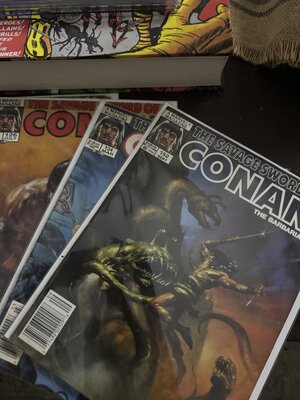
Why Conan doesn’t sell well is beyond me. I picked up some Savage sword magazines for like $5 at my lcs. The Frazetta-style fantasy artwork by Smith and Buscema is top-notch! It seems like a lot of people are happy to just buy AI slop nowadays or artwork that doesn’t measure up to what it used to be.

IMG_2913.jpeg

I keep my books stored in plastic bins with no problems (you’re overthinking that one). Just make sure they’re lined up properly and not just crammed in there. Leave the books outside before storing them to clear out the weed odor I suppose (never dealt with that issue).

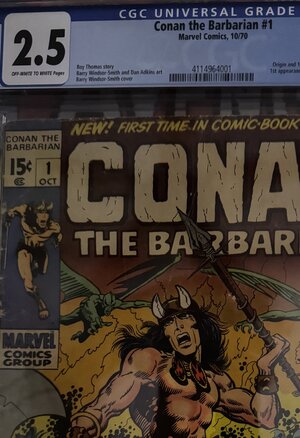
Rant: I sent my Conan #1 to CGC for grading, and they sent it back as a 2.5. They act like my dogs were chewing on it! The pages were cleaned and still crisp. Yeah it’s worn with a nasty spine..but wasn’t expecting that low of a grade. I don’t know if the grader didn’t get laid that night, didn’t have their coffee that morning, or what, but I expected at least something in the 4s. Either way, they potentially screwed me out of a few hundred dollars. Now I’m nervous to send in some Strange Tales that need grading. Thinking about using CBCS instead.

IMG_2914.jpeg
 
R.I.P. Peter David

Sad to hear that writer extraordinaire Peter David has passed away at 68. He was one of my favorite comic book writers back in the 80s. His Incredible Hulk run was legendary. His X-Factor was a refreshing, hilarious romp. He made Aquaman cool and a badass. His Spider-Man 2099 was solid.

bb9d2-17482181680980.jpg
 
Jim Shooter, Teenage Comics Writer Who Revolutionized Marvel as Editor-in-Chief, Dies at 73

Main-(10)-1751346787583.jpg


Jim Shooter, the comics industry titan who went from teenage writing prodigy to seminal but divisive editor-in-chief for Marvel Comics in the 1980s, has died after a battle with esophageal cancer. He was 73.

His death was announced Monday on Facebook by writer-editor Mark Waid and confirmed to The Hollywood Reporter by his son, Benjamin Shooter.

Shooter came of age in an industry that was both staid and stuck in traditions yet unusually open in a way that a phone call from an editor to a kid could make dreams come true.

He wrote stories that he sent into National Comics — as DC was known at the time — in the mid-1960s when he was in his early teens, prompting an out of the blue phone call from legendary editor Mort Weisinger, who would buy the stories and put Shooter on the payroll. It was a boon for the youngster, who could now help out his struggling blue collar family whose patriarch was a steelworker in Pennsylvania.

Shooter aped Marvel Comics’ writing style, bringing a measure of 1960s cool to the more uptight comics that National put out. He created new members of the Legion of Super-Heroes, the group of costumed teens created in the Eisenhower 1950s, adding Karate Kid and Ferro Lad to the line while also birthing the villainous Fatal Five. He also created the Superman bad guy known as Parasite.

Although he became a local celebrity, he left comics for several years before returning, again at DC in early 1970s and again penning Superman and Legion stories. Then Marvel editor Marv Wolfman plucked him to be an editorial assistant and writer starting in 1976. Two years later, thanks to a tumult in the comics industry, Shooter became editor-in-chief. He was only 26.

Thus began a remarkable run that has little parallel in modern comics publishing. Shooter professionalized what had been a loose company in an even looser industry, making sure books were published on time, artists were paid on time and even given royalties and health insurance.

He also had a flair for developing talent, and under his aegis Marvel put out now-classic stories from writer Chris Claremont and artist John Byrne on Uncanny X-Men, Frank Miller on Daredevil and Walt Simonson on Thor, among others. While the artists became among the biggest names in the industry, X-Men became not only the most dominant and influential comic of the decade and beyond, but one of the first true franchises of the industry.

With 1984’s Secret Wars, a 12-issue miniseries that Shooter, Mike Zeck and John Beatty drew, he instituted the concept of publishing crossover events, a companywide initiative that saw one main story play out and influence many of the other titles coming out for months on end. Secret Wars was a massive publishing success and a toy bonanza. It’s a concept that is still being used by Marvel and DC to this day, in varying degrees.

He took fans seriously, and just like Weisinger, called and wrote readers out of the blue. Carter Beats the Devil author Glen David Gold wrote in his 2018 memoir, I Will Be Complete, of how in the summer before he entered high school in the late 1970s, Shooter phoned after reading a SHIELD story he had sent in. Perhaps seeing something of himself in a teen writing superhero stories, Shooter was encouraging, telling the auspicious writer to read as much as he could in high school and to study science.

But despite the successes, and Marvel’s growing corporatization and assured dominance in comics, Shooter’s hard-driving and micro-managerial style began to alienate talent and editors. He drove Miller to DC — twice — where the creator left an artistic mark on literature and pop culture with his masterpiece, The Dark Knight Returns. He pushed Byrne to DC, where the writer-artist’s Superman relaunch became such a media event it made it to the cover of Time magazine.

Still, while many call Shooter a “complicated man,” Larry Hama, who was writing G.I. Joe: A Real American Hero for Marvel as well as editing titles, said that he believed Shooter was always trying to do the right thing. Hama recalled on Facebook how Shooter put a writer-artist on the company’s insurance plan the day after he died in order to help out his widow. (The talent had qualified for the health and insurance plan and wanted to sign up, but Marvel policy only allowed for sign-ups on Wednesdays. The man had died on the Tuesday.)

Hama wrote, “Without hesitation, Jim took the paperwork from me and went upstairs to push it through. He said, ‘They owe it to him, we just won’t mention that he already passed.’ I witnessed him doing stuff like that several times. None of it was made public for obvious reasons. It could have cost him his job, but he did the right thing.”

Shooter was indeed fired by Marvel in 1987 — a failed publishing initiative and the rough relations with editors and talent finally taking their toll. But he remained a player in the industry and a few years later launched Valiant Comics, a company that in the 1990s rebooted such comic characters as Magnus, Robot Fighter and Solar, Man of the Atom while created new heroes in an attempt to compete with Marvel and DC. He even brought along Marvel veterans Bob Layton, Barry Windsor-Smith and Don Perlin, among others, for the venture.

Shooter moved on to another launch another comics company, the short-lived Broadway Comics, which was an offshoot of Broadway Video, the production banner run by Lorne Michaels. Stints at other and lesser independent companies followed as he drifted from the power center of an industry he had helped shape. He remained active, returning briefly to write Legion of Super-Heroes for DC in 2007 and writing comics for Dark Horse in the early 2010.

“Jim was an excellent superhero writer, a character creator, an editor with an eagle eye and a man who gave his all to what he did,” Paul Levitz, the former president of DC Comics who worked as a comics author and editor in the 1970s and ’80s, wrote on Facebook.

Levitz, who was Shooter’s contemporary as well as a poker-playing buddy, offered a clear-eyed assessment in his remembrance: “From my perspective, he was far weaker as an enterprise leader, and unfortunately that was what he most wanted to be. His sense of history was not, in my view, as good as his sense of fiction. But what he did well, he did gloriously … and my inner child will always be grateful for his inspiration.”

 
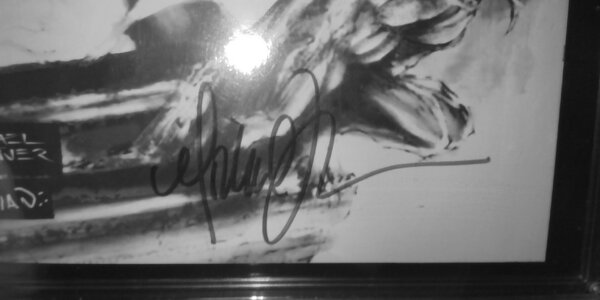
IMG_20250618_225327_996.jpg

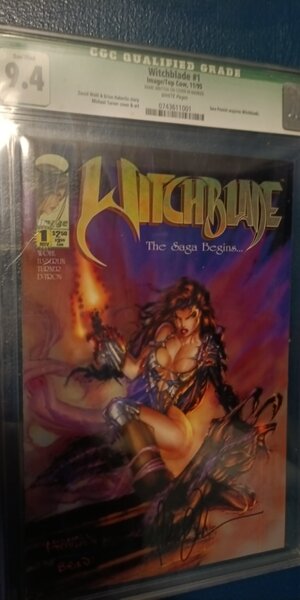
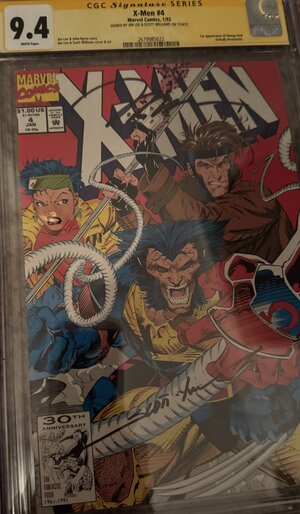
Picked this up from eBay for quite cheap.
The seller claimed, but the CGC doesn't confirm, that the signature on the cover is Michael Turner the legendary illustrator R.I.P.2008.

The price was the same as other 9.4 grades without the signature, so I decided to take a risk.

After it arrived I went on Reddit to the ImageComics subreddit and posted this pic asking "Who's signature is this?"

IMG_20250618_220029_057.jpg
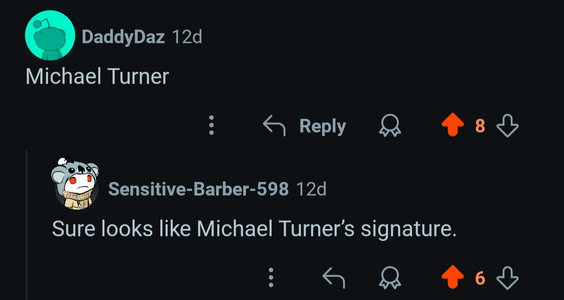
And the two answers, without implying what answer I wanted are -

Screenshot_20250701-194411.png

Boom.
That practically confirms it in my mind, and that's good enough for me. Bought it to collect it and not eventually sell it.
 
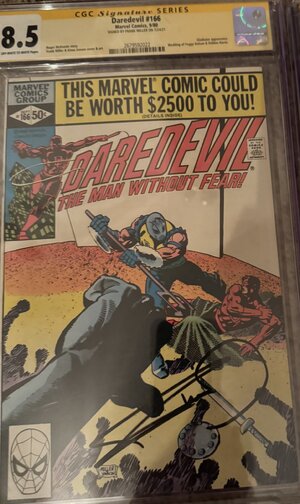
Some pickups I won at an auction on eBay live. DD #166 with Frank Miller sig I paid next to nothing for.
IMG_3105.jpeg
The guy running his auction was like I have to go.
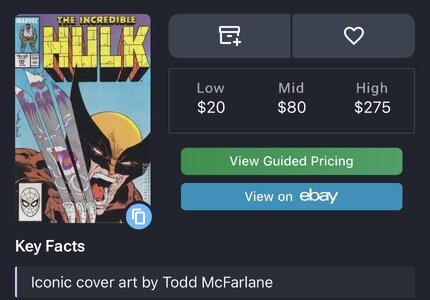
So after I won the DD slab a guy picked up a newsstand 9.2 of hulk #340 signed by McFarlane for $25 lucky dog!
<{blankeye}>


IMG_3110.jpeg

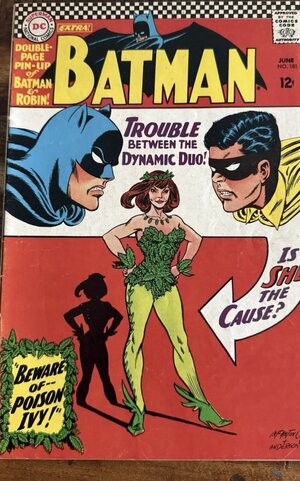
I did get burned buying Batman 181 (first appearance of poison Ivy) and it was nothing like the pic,someone took a hole puncher to this one,total beater so I’m mailing that shit back. (Not my book 😡)v
IMG_3109.jpeg

IMG_3107.jpeg
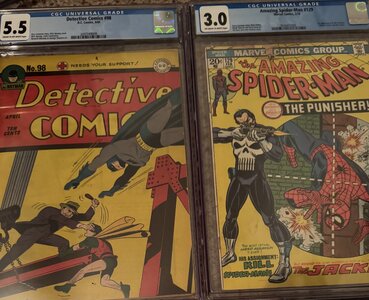
3.0 on the ASM#129 was a gift.
IMG_3104.jpeg
IMG_3106.jpeg
 
Last edited:
Jim Shooter, Teenage Comics Writer Who Revolutionized Marvel as Editor-in-Chief, Dies at 73

Main-(10)-1751346787583.jpg


Jim Shooter, the comics industry titan who went from teenage writing prodigy to seminal but divisive editor-in-chief for Marvel Comics in the 1980s, has died after a battle with esophageal cancer. He was 73.

His death was announced Monday on Facebook by writer-editor Mark Waid and confirmed to The Hollywood Reporter by his son, Benjamin Shooter.

Shooter came of age in an industry that was both staid and stuck in traditions yet unusually open in a way that a phone call from an editor to a kid could make dreams come true.

He wrote stories that he sent into National Comics — as DC was known at the time — in the mid-1960s when he was in his early teens, prompting an out of the blue phone call from legendary editor Mort Weisinger, who would buy the stories and put Shooter on the payroll. It was a boon for the youngster, who could now help out his struggling blue collar family whose patriarch was a steelworker in Pennsylvania.

Shooter aped Marvel Comics’ writing style, bringing a measure of 1960s cool to the more uptight comics that National put out. He created new members of the Legion of Super-Heroes, the group of costumed teens created in the Eisenhower 1950s, adding Karate Kid and Ferro Lad to the line while also birthing the villainous Fatal Five. He also created the Superman bad guy known as Parasite.

Although he became a local celebrity, he left comics for several years before returning, again at DC in early 1970s and again penning Superman and Legion stories. Then Marvel editor Marv Wolfman plucked him to be an editorial assistant and writer starting in 1976. Two years later, thanks to a tumult in the comics industry, Shooter became editor-in-chief. He was only 26.

Thus began a remarkable run that has little parallel in modern comics publishing. Shooter professionalized what had been a loose company in an even looser industry, making sure books were published on time, artists were paid on time and even given royalties and health insurance.

He also had a flair for developing talent, and under his aegis Marvel put out now-classic stories from writer Chris Claremont and artist John Byrne on Uncanny X-Men, Frank Miller on Daredevil and Walt Simonson on Thor, among others. While the artists became among the biggest names in the industry, X-Men became not only the most dominant and influential comic of the decade and beyond, but one of the first true franchises of the industry.

With 1984’s Secret Wars, a 12-issue miniseries that Shooter, Mike Zeck and John Beatty drew, he instituted the concept of publishing crossover events, a companywide initiative that saw one main story play out and influence many of the other titles coming out for months on end. Secret Wars was a massive publishing success and a toy bonanza. It’s a concept that is still being used by Marvel and DC to this day, in varying degrees.

He took fans seriously, and just like Weisinger, called and wrote readers out of the blue. Carter Beats the Devil author Glen David Gold wrote in his 2018 memoir, I Will Be Complete, of how in the summer before he entered high school in the late 1970s, Shooter phoned after reading a SHIELD story he had sent in. Perhaps seeing something of himself in a teen writing superhero stories, Shooter was encouraging, telling the auspicious writer to read as much as he could in high school and to study science.

But despite the successes, and Marvel’s growing corporatization and assured dominance in comics, Shooter’s hard-driving and micro-managerial style began to alienate talent and editors. He drove Miller to DC — twice — where the creator left an artistic mark on literature and pop culture with his masterpiece, The Dark Knight Returns. He pushed Byrne to DC, where the writer-artist’s Superman relaunch became such a media event it made it to the cover of Time magazine.

Still, while many call Shooter a “complicated man,” Larry Hama, who was writing G.I. Joe: A Real American Hero for Marvel as well as editing titles, said that he believed Shooter was always trying to do the right thing. Hama recalled on Facebook how Shooter put a writer-artist on the company’s insurance plan the day after he died in order to help out his widow. (The talent had qualified for the health and insurance plan and wanted to sign up, but Marvel policy only allowed for sign-ups on Wednesdays. The man had died on the Tuesday.)

Hama wrote, “Without hesitation, Jim took the paperwork from me and went upstairs to push it through. He said, ‘They owe it to him, we just won’t mention that he already passed.’ I witnessed him doing stuff like that several times. None of it was made public for obvious reasons. It could have cost him his job, but he did the right thing.”

Shooter was indeed fired by Marvel in 1987 — a failed publishing initiative and the rough relations with editors and talent finally taking their toll. But he remained a player in the industry and a few years later launched Valiant Comics, a company that in the 1990s rebooted such comic characters as Magnus, Robot Fighter and Solar, Man of the Atom while created new heroes in an attempt to compete with Marvel and DC. He even brought along Marvel veterans Bob Layton, Barry Windsor-Smith and Don Perlin, among others, for the venture.

Shooter moved on to another launch another comics company, the short-lived Broadway Comics, which was an offshoot of Broadway Video, the production banner run by Lorne Michaels. Stints at other and lesser independent companies followed as he drifted from the power center of an industry he had helped shape. He remained active, returning briefly to write Legion of Super-Heroes for DC in 2007 and writing comics for Dark Horse in the early 2010.

“Jim was an excellent superhero writer, a character creator, an editor with an eagle eye and a man who gave his all to what he did,” Paul Levitz, the former president of DC Comics who worked as a comics author and editor in the 1970s and ’80s, wrote on Facebook.

Levitz, who was Shooter’s contemporary as well as a poker-playing buddy, offered a clear-eyed assessment in his remembrance: “From my perspective, he was far weaker as an enterprise leader, and unfortunately that was what he most wanted to be. His sense of history was not, in my view, as good as his sense of fiction. But what he did well, he did gloriously … and my inner child will always be grateful for his inspiration.”

RIP Legend.

The past 5 years has been absolultely ruthless to legendary comicbook creatives.
 
RIP Legend.

The past 5 years has been absolultely ruthless to legendary comicbook creatives.
RIP

I'll always have a soft spot for Jim Shooter. The man was responsible for my favorite childhood moments with his editorial run with Marvel Comics. I also remember being so amazed at the concept of Secret Wars which galvanized me to become a full-time comic book collector at the time.
 
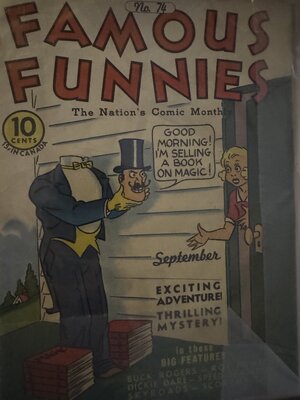
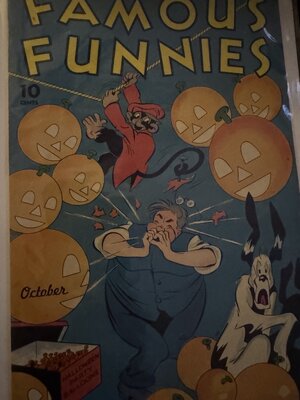
Pickups for this month.

People may shit on eBay live and whatnot (rightfully so) I’ve had some bad experiences there but last night I went to a stream where there was only 8 people in the room. I thought it was going to be a guy selling bullshit..wrong! this guy was selling massive keys and grails for $1 starts. Super crisp to,you can tell this guy cleaned and pressed his own books. I started to pay more because I felt bad buying his books for nothing.

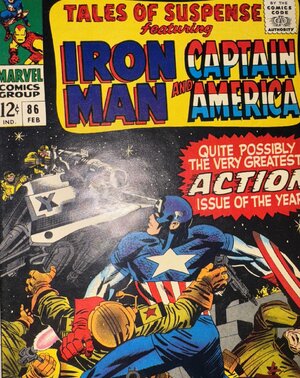
I’ll post pics once they’re mailed,I picked up some tales of suspense and nick fury to complete my collection,what a lucky grab.
IMG_3142.jpeg
IMG_3140.jpeg
IMG_3141.jpeg
IMG_3126.jpeg
IMG_3128.jpeg
IMG_3127.jpeg

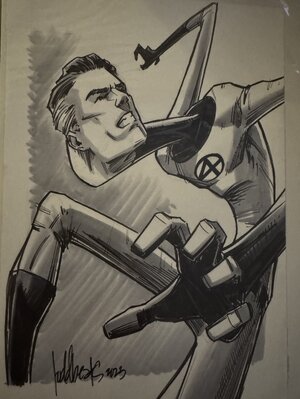
Todd Beats FF4 RR sketch (bought during his battle beast signings)

IMG_3125.jpeg
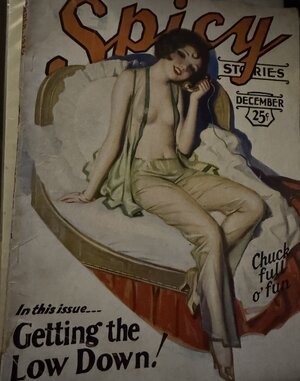
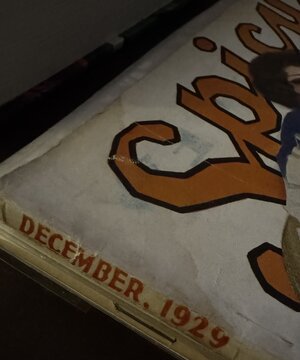
“SPICY” just because I wanted to own something almost a 100 years old (1929). The only thing “spicy” is a crude drawing of a lady with her titts hanging out..different times I guess.

IMG_3129.jpeg

IMG_3130.jpeg
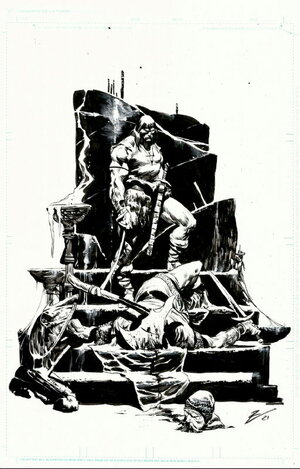
Frazetta has always been my favorite artist I’m looking to buy his work next. Getting rid of a lot of the bs to free up space then I’ll just own a few choice pieces.🤌
IMG_3143.jpeg
 
Back
Top