• We are currently experiencing technical difficulties. We sincerely apologize for the inconvenience.

Social Do you quit or do you stick things out?

SmoothPies

Brown Belt
@Brown
Joined
Apr 2, 2015
Messages
2,533
Reaction score
6,350
Clickbait title, but let me explain. I have this theory, maybe it's a stupid one.

My theory is that everyone you know can be divided into one of two groups: people that quit, and people that stick things out.

You might read that sentence and think - the first group is a negative, and the second is a positive - but not necessarily.

Someone that quits might stop trying out for a team that deep down they want to go for, that's of course a negative. But on the flip side - they are quick to hit the escape button on a toxic relationship, or leave that job they hate after only a few weeks in.

Someone that sticks things out might become a master at the violin, because they never gave up. They might become a great doctor because they got through all of the many years of schooling it takes. They might also keep that person in their life they probably should have cut out a long time ago - or they could stay at they company they hate working for.

I fall into the first category, I quit things easily. I can think of many times this has hurt me, and some times that it has helped me.

What group do you fall in, or is it not as black and white as this?
 
I tend to stick things out. I’ve kept at my goals but at the same time I’ve also kept people around I should have dropped a looooong time ago.
 
Definitely not black and white, it's about balance. On one end of the spectrum you have people who are too stubborn and inflexible, who will stick to a way of doing things or to a certain plan, no matter the outcome, even if there are clear signs that they may have made a mistake, or that new circumstances require a new plan, which is not the same as having grit or discipline. Some people are afraid of change, become arrogant, or let their identity become too attached to a certain course of action, such that giving it up hurts their ego too much, and they become delusional. Their persistence hides a type of weakness as well. The "sunken cost fallacy" is one example of why some people may stick to a plan, even if it's not beneficial to stay the course.

On the other you end you have people who are fickle, mentally weak, unreliable, or lacking conviction. Knowing when to cut your losses and call it quits on something is an important skill in life, but it has to be done out of a legitimate principled conviction that you were wrong to take a certain path, or that you learned new information that legitimately changed your perception of a situation, not because something feels temporarily unpleasant, or because someone else pressured you to do so.
 
Definitely not black and white, it's about balance. On one end of the spectrum you have people who are too stubborn and inflexible, who will stick to a way of doing things or to a certain plan, no matter the outcome, even if there are clear signs that they may have made a mistake, or that new circumstances require a new plan, which is not the same as having grit or discipline. Some people are afraid of change, become arrogant, or let their identity become too attached to a certain course of action, such that giving it up hurts their ego too much, and they become delusional. Their persistence hides a type of weakness as well. The "sunken cost fallacy" is one example of why some people may stick to a plan, even if it's not beneficial to stay the course.

On the other you end you have people who are fickle, mentally weak, unreliable, or lacking conviction. Knowing when to cut your losses and call it quits on something is an important skill in life, but it has to be done out of a legitimate principled conviction that you were wrong to take a certain path, or that you learned new information that legitimately changed your perception of a situation, not because something feels temporarily unpleasant, or because someone else pressured you to do so.

That's the ideal, being in the center - and I suppose some people find that balance. I personally believe most fall toward one side or the other, for better or worse
 
That's the ideal, being in the center - and I suppose some people find that balance. I personally believe most fall toward one side or the other, for better or worse
Well, I'm not sure it's correct to be right in the middle either. I think most people give up on things too easily, especially now, with people having short attention spans, and with short-term gratification being pushed from all sides from a young age. So, I think it's good to train yourself to stick to difficult things that require a long-term commitment, because this comes a lot less naturally to people than quitting. But it's good to perform periodic checks to make sure you aren't just going through the motions due to inertia or fear of change.
 
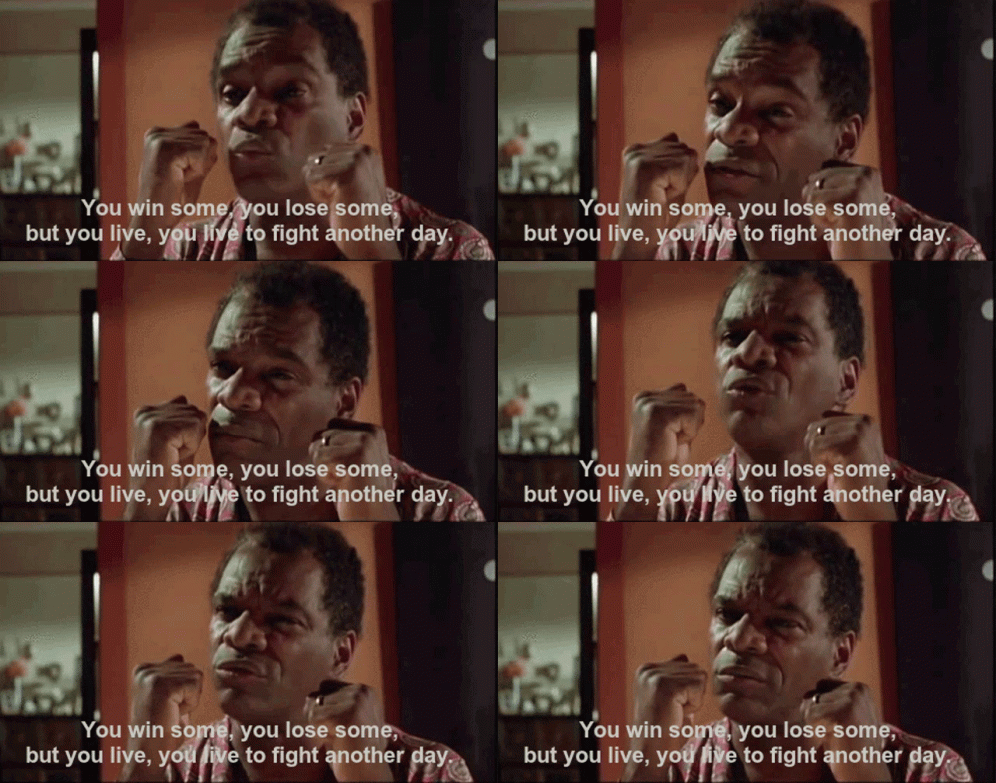
you-win-some-you-lose-some.gif
 
I always try to stick it out. Too long in some cases. I don’t know when to quit. In some scenarios, that is a gift. In others, it is a curse.
 
I'm generally a quitter.


Unless I'm at the gay gloryholes.
 
It's all very circumstantial. I'll stick out for things I genuinely want or think is worth it, and will quickly quit things I don't perceive as worth it. It doesn't take an eternity to weigh out pros and cons and make a decision.

People who stick out long-term for things that make them unhappy, probably don't see any other viable options. Whether that be a job, or a relationship, or whatever.
 
I'm a quitter when it comes to romantic relationships, but the real issue is that I deep down don't want it.
 
@Volador said it pretty much perfectly.

I think there is time to stick it out and there is a time to quit. You just have to figure it out somehow, yes sometimes you have to go through mistakes / failures to be more efficient person. It's just the way it goes. I believe adaptation is the key to not only surviving in life but to thrive as well.

And definitely there has to be a balance.
 
For six months I paid a lot of money, and put in a lot of effort and time into trying to keep my bunny alive. They still died in the end. Learned my lesson the hard way.
 
Back
Top