

- Joined
- Nov 24, 2018
- Messages
- 29,043
- Reaction score
- 105,338
Not sure what to think about that but definitely interesting stuff... Hank Scorpio x Jonestown x Fyre Fest Mashup 
https://www.bloomberg.com/news/arti...ras-a-private-tech-city-now-open-for-business
If you’re going to work remotely, Próspera is a nice place to do it. Located on Roatán, a tropical island off the coast of Honduras, it features a series of airy offices and communal outdoor spaces with ocean views. There are other real estate developments on the island, but Próspera is the only one with its own set of laws and governing system.
Próspera is the first project to gain approval from Honduras to start a privately governed charter city, under a national program started in 2013. It has its own constitution of sorts and a 3,500-page legal code with frameworks for political representation and the resolution of legal disputes, as well as minimum wage (higher than Honduras’s) and income taxes (lower in most cases). After nearly half a decade of development, the settlement will announce next week that it will begin considering applications from potential residents this summer.
The first colonists will be e-residents. Próspera doesn’t yet have housing ready to be occupied. But even after the site is built out, most constituents will never set foot on local soil, says Erick Brimen, the chief executive officer of Honduras Próspera. Instead, Brimen expects about two-thirds of Prósperans to sign up for residency in order to incorporate businesses there or take jobs with local employers while living elsewhere.
For many Central Americans, Brimen says it’ll be an attractive alternative to the meager economic opportunities afforded elsewhere in the region, whose governments he considers to be bureaucratic and corrupt. “You can have the rule of law virtually,” Brimen says.
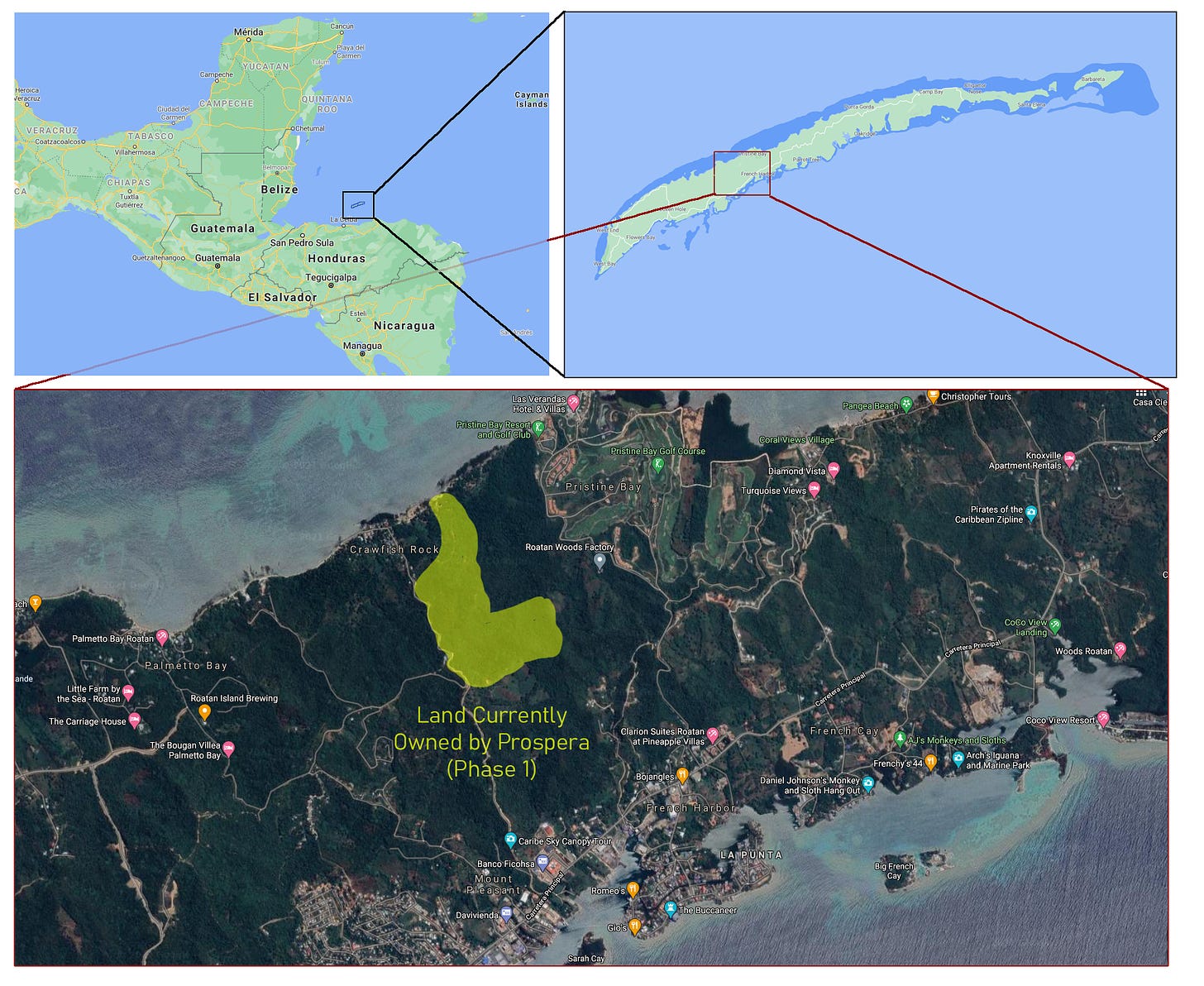
The idea behind charter cities, along with their predecessor seasteading, which sought to create independent nations floating in the ocean, is to compete for citizens through innovative, business-friendly governing systems. For some reason, the idea has long been linked to Honduras, an impoverished country whose governing system is classified as “partly free” by the human rights organization Freedom House. Paul Romer, an American economist who pioneered the idea of charter cities, tried to start one in the country a decade ago. It failed, but Honduras has spent much of the time since then writing a law to enable such cities, which are known in the country as Zedes, short for zonas de empleo y dessarollo económicos (employment and economic development zones).
But the prospect of creating pockets of prosperity that play by their own rules is controversial for obvious reasons. Próspera has drawn protests from local residents who see a lack of transparency and little to gain from its existence, and a group of local political leaders signed a letter of opposition in October. This month, an arm of the Technical University of Munich said it’s reevaluating its relationship with Próspera and that it generally withdraws from projects if there are indications of human rights violations. Representatives for TUM didn’t respond to requests to elaborate. A spokeswoman for Próspera says it has had a “great working relationship with TUM over the years.”
After years of debate, Próspera will be the first real-world test of a divisive libertarian idea, says Beth Geglia, an anthropologist who studies charter cities. “There was a noticeable lull in the startup city movement in general until the Próspera Zede project got off the ground,” she says. “It’s ground zero.”

https://astralcodexten.substack.com/p/prospectus-on-prospera
Who among us hasn't looked out at the great edifice of human civilization in all its complexity, and thought "Yeah okay but I could do it better"? Centuries of utopian communes, micronations, and seasteads have dreamed of rebuilding society from first principles, free from entrenched interests and the debris of the past. If you got all the laws and values just right, maybe you could prevent poverty and corruption from finding their first footholds. Do the "liberty and justice for all" thing, but for real.
And who among us, having had the dream, hasn't entered into multi-year negotiations with the government of Honduras? Taken advantage of a clause in the Honduras-Kuwait Treaty Of Reciprocal Investment guaranteeing them their right to pursue their vision unmolested? Raised millions in venture capital and bought land on a Caribbean island to turn it into a reality?



https://www.bloomberg.com/news/arti...ras-a-private-tech-city-now-open-for-business
If you’re going to work remotely, Próspera is a nice place to do it. Located on Roatán, a tropical island off the coast of Honduras, it features a series of airy offices and communal outdoor spaces with ocean views. There are other real estate developments on the island, but Próspera is the only one with its own set of laws and governing system.
Próspera is the first project to gain approval from Honduras to start a privately governed charter city, under a national program started in 2013. It has its own constitution of sorts and a 3,500-page legal code with frameworks for political representation and the resolution of legal disputes, as well as minimum wage (higher than Honduras’s) and income taxes (lower in most cases). After nearly half a decade of development, the settlement will announce next week that it will begin considering applications from potential residents this summer.
The first colonists will be e-residents. Próspera doesn’t yet have housing ready to be occupied. But even after the site is built out, most constituents will never set foot on local soil, says Erick Brimen, the chief executive officer of Honduras Próspera. Instead, Brimen expects about two-thirds of Prósperans to sign up for residency in order to incorporate businesses there or take jobs with local employers while living elsewhere.
For many Central Americans, Brimen says it’ll be an attractive alternative to the meager economic opportunities afforded elsewhere in the region, whose governments he considers to be bureaucratic and corrupt. “You can have the rule of law virtually,” Brimen says.
The idea behind charter cities, along with their predecessor seasteading, which sought to create independent nations floating in the ocean, is to compete for citizens through innovative, business-friendly governing systems. For some reason, the idea has long been linked to Honduras, an impoverished country whose governing system is classified as “partly free” by the human rights organization Freedom House. Paul Romer, an American economist who pioneered the idea of charter cities, tried to start one in the country a decade ago. It failed, but Honduras has spent much of the time since then writing a law to enable such cities, which are known in the country as Zedes, short for zonas de empleo y dessarollo económicos (employment and economic development zones).
But the prospect of creating pockets of prosperity that play by their own rules is controversial for obvious reasons. Próspera has drawn protests from local residents who see a lack of transparency and little to gain from its existence, and a group of local political leaders signed a letter of opposition in October. This month, an arm of the Technical University of Munich said it’s reevaluating its relationship with Próspera and that it generally withdraws from projects if there are indications of human rights violations. Representatives for TUM didn’t respond to requests to elaborate. A spokeswoman for Próspera says it has had a “great working relationship with TUM over the years.”
After years of debate, Próspera will be the first real-world test of a divisive libertarian idea, says Beth Geglia, an anthropologist who studies charter cities. “There was a noticeable lull in the startup city movement in general until the Próspera Zede project got off the ground,” she says. “It’s ground zero.”
https://astralcodexten.substack.com/p/prospectus-on-prospera
Who among us hasn't looked out at the great edifice of human civilization in all its complexity, and thought "Yeah okay but I could do it better"? Centuries of utopian communes, micronations, and seasteads have dreamed of rebuilding society from first principles, free from entrenched interests and the debris of the past. If you got all the laws and values just right, maybe you could prevent poverty and corruption from finding their first footholds. Do the "liberty and justice for all" thing, but for real.
And who among us, having had the dream, hasn't entered into multi-year negotiations with the government of Honduras? Taken advantage of a clause in the Honduras-Kuwait Treaty Of Reciprocal Investment guaranteeing them their right to pursue their vision unmolested? Raised millions in venture capital and bought land on a Caribbean island to turn it into a reality?


